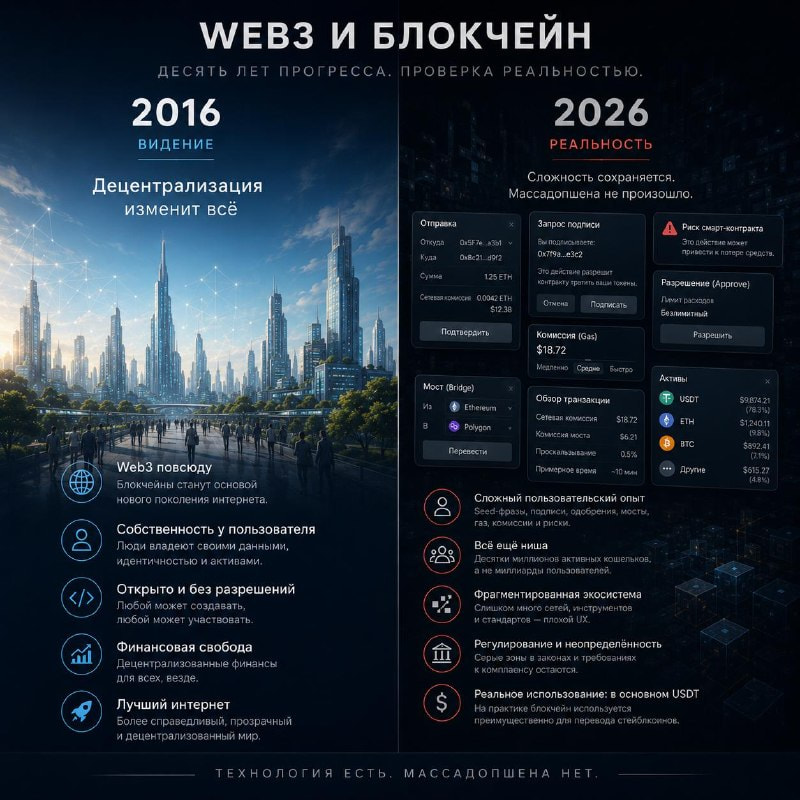
It's been ten years since the first promises that Web3 and cryptocurrency would become integral parts of our daily lives. However, the reality turned out differently. Today, amidst the crypto winter, we're not only surviving but also reflecting on why mass adoption hasn't happened.
A Decade in Review: What Happened to Web3?
Throughout the decade, we envisioned a future where everyone would use non-custodial wallets, decentralized applications, and financial services without intermediaries. However, the main takeaway is that cryptocurrency and Web3 have not become mainstream products.
Cryptocurrency: Ownership Doesn't Equal Usage
Despite hundreds of millions owning cryptocurrency, this doesn't translate to widespread use of Web3. By 2025, it's expected that there will be around 741 million crypto owners, but that's just one side of the coin.
- How many people regularly use non-custodial wallets?
- How many interact with decentralized applications at least once a month?
- How many understand concepts like gas fees, seed phrases, bridges, smart contract risk, and approvals?
In reality, activity in the dApp industry is measured not by billions of users but by tens of millions of active wallets daily. Moreover, one wallet doesn't always correspond to one user, making these statistics even less impressive.
AI: An Example of Rapid Mass Adoption
In contrast to Web3's slow progress, artificial intelligence technologies like ChatGPT demonstrate much faster mass adoption. They are straightforward and accessible to everyday users: ask a question and get an answer.
AI doesn't require creating wallets, storing seed phrases, or understanding complex technical aspects. This is its main advantage over Web3.
Web3's Challenges from a Layperson's Perspective
For the average person, cryptocurrency is still:
- complex;
- inconvenient;
- risky;
- prone to error;
- tainted with a gray reputation;
- not fully accepted by governments and regulators.
While the idea of decentralization is appealing, it often loses out to the simple question: "Why bother if a regular app works just fine?"
The Future of Web3: Where Are We Headed?
Over the past 10 years, Web3 hasn't become a mainstream consumer product. It remains an important and promising, yet still niche, technological field.
We continue to work in this market, developing blockchain projects and recognizing their benefits for specific tasks. However, true mass adoption of Web3 has yet to occur. Perhaps the coming years will reveal whether it can transition from a complex engineering niche to a normal consumer product or remain a technology for those willing to endure complexity for the sake of control and decentralization.

Alex Meleshko
Entrepreneur, CEO, and builder at the intersection of blockchain, AI, and startups.
Comments
No comments yet. Be the first!