Stablecoins: A Real Web3 Use Case in the Economy
When people talk about blockchain, they often mention phenomena like crypto trading, tokens, NFTs, DeFi, or the latest meme coin. However, in my opinion, one of the most viable and comprehensible Web3 scenarios has long existed outside these topics. That scenario is stablecoins.
What are Stablecoins and Why Are They Important?
A stablecoin is a token that aims to maintain a stable price, usually pegged to the dollar. For example, 1 USDT, 1 USDC, or 1 DAI is approximately equal to one dollar. Unlike Bitcoin or Ethereum, the goal of a stablecoin is not price appreciation but to serve as a convenient digital form of the dollar that can be used across various networks and products.
Who Controls the Stablecoin Market?
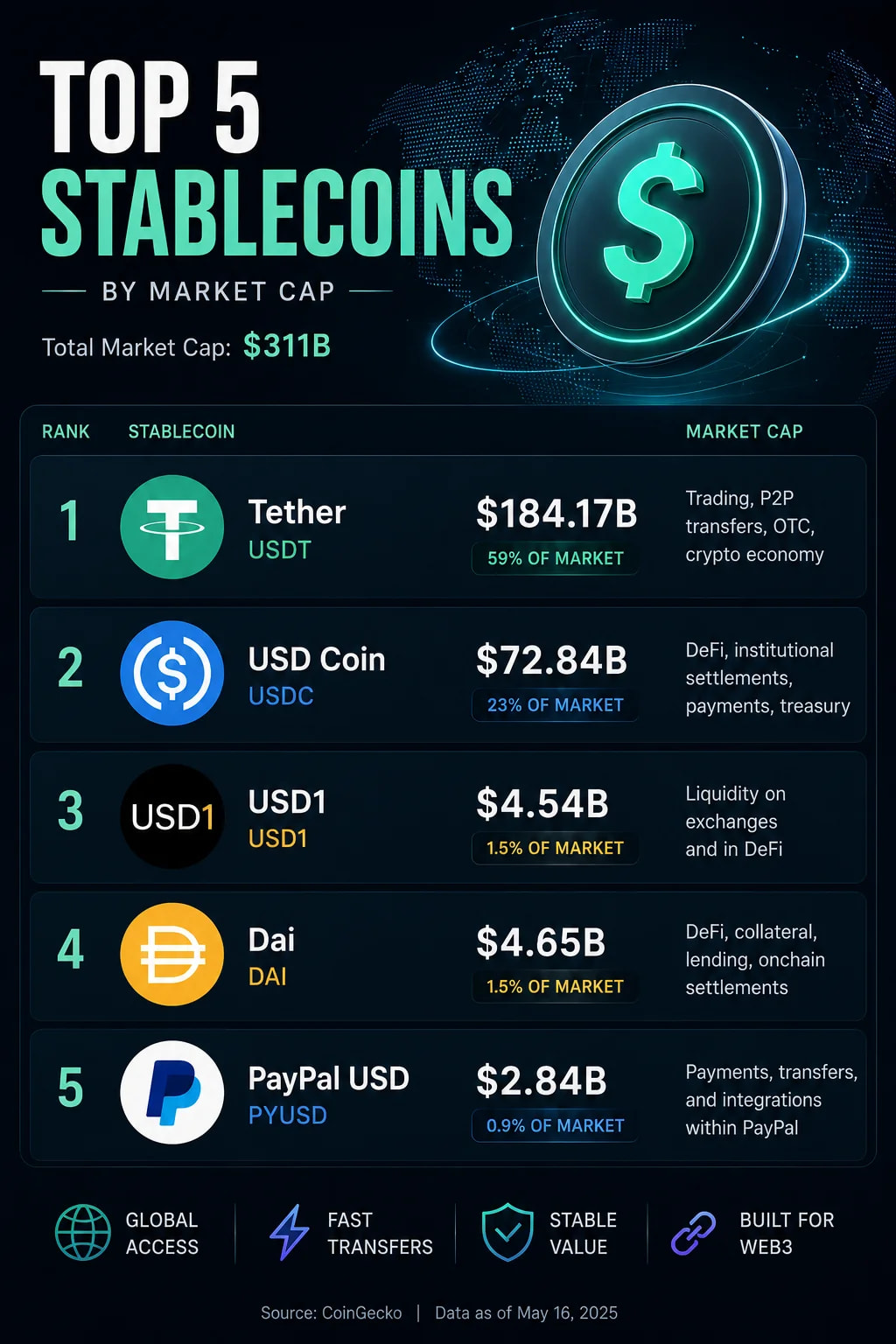
The stablecoin market is highly concentrated. The main players are USDT, USDC, DAI, and PYUSD.
USDT
- The largest stablecoin in the world.
- Market capitalization of about $184 billion, with a daily trading volume of $35 billion.
- Used on centralized exchanges, in P2P transfers, international settlements, and trading.
USDC
- Issued by Circle and associated with a more institutional and regulated market.
- Market capitalization of $73 billion, with a daily turnover of $6–7 billion.
- Popular in DeFi, corporate operations, and fintech integrations.
DAI
- A decentralized stablecoin not issued by a traditional company.
- Market capitalization of $4.6 billion, with a daily trading volume of $100 million.
- Actively used in DeFi for loans, liquidity, and yield strategies.
PYUSD
- A stablecoin from PayPal, notable for its approach to integrating traditional payment services with blockchain.
- Used for payments, transfers, and within the PayPal ecosystem.
Real-World Use of Stablecoins
While trading and arbitrage often dominate stablecoin volumes, their real-world applications extend far beyond these areas.
International B2B Settlements
Stablecoins are becoming an essential tool for companies operating across different countries, enabling fast and cheap transfers.
Person-to-Person Transfers
People use stablecoins to send money to family members, receive payments for work, and transfer funds across countries, especially in regions with unstable currencies.
DeFi and Programmable Liquidity
In DeFi, stablecoins act as programmable financial infrastructure, allowing them to be used in loans, liquidity, and smart contracts.
Cards and Everyday Payments
Payment cards linked to stablecoins allow users to make purchases like a regular card, with conversion handled by the provider.
Stablecoins as the Main Web3 Scenario
Stablecoins answer a simple question: how to quickly and conveniently transfer dollars over the internet? They haven't replaced banks or cards but have become crucial infrastructure for the crypto market, international transfers, and Web3 products. Perhaps stablecoins will enable blockchain to cease being a niche technology by posing more straightforward questions and offering effective solutions.

Alex Meleshko
Entrepreneur, CEO, and builder at the intersection of blockchain, AI, and startups.
Comments
No comments yet. Be the first!