More Than Half of CoinGecko-Listed Cryptocurrencies Have Died — What It Says About Web3 Startup Survival
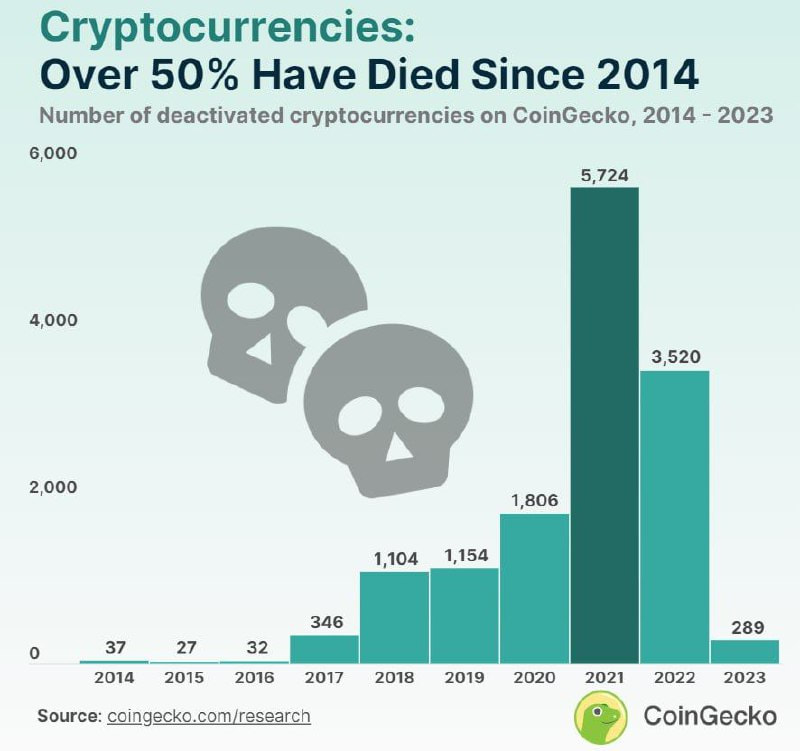
More than 50% of crypto projects don’t make it
CoinGecko recently highlighted a brutal statistic: more than half of all cryptocurrencies ever listed on its platform have effectively stopped existing. Since 2014, 14,039 projects have “died,” and the cohort launched during the 2021 bull market suffered the most.
It’s a sobering reminder that, in crypto, the long tail is mostly a graveyard.
Blockchain startup mortality is high—just like in IT
From my perspective as a founder, this doesn’t feel surprising. The startup death rate in the blockchain market is high—arguably as high as in IT in general. It’s hard to compare across industries and give an exact percentage because the definitions vary:
- What counts as “dead”—no trading volume, abandoned repos, delisted tokens, bankrupt companies?
- Are we measuring token survival, company survival, or product survival?
- Do pivots count as failure or adaptation?
Still, the direction is clear: a huge number of crypto experiments don’t reach long-term sustainability.
But there’s a positive signal: more projects launch every year
What I do find encouraging is that in absolute numbers, more blockchain projects are being launched each year. Even if the survival percentage stays roughly the same over time, the ecosystem continues to produce more attempts, more teams, and more innovation.
Of course, survival isn’t uniform. There’s an obvious dependency on market conditions—especially where in the cycle a project is launched. The 2021 bull market is a great example: when capital is easy and attention is abundant, the market funds (and overfunds) an enormous number of ideas. The following downturn then becomes a harsh filter for product-market fit, runway management, and real demand.
A question for founders and investors
If more than half of listed crypto assets eventually disappear, it raises a practical question for anyone building or allocating capital in Web3:
What do you think the survival rate of a blockchain startup is after 1, 2, and 3 years?
It’s a useful mental model—not to be pessimistic, but to be realistic about timelines, burn rates, and the importance of building something people will still need when the market cools off.

Alex Meleshko
Entrepreneur, CEO, and builder at the intersection of blockchain, AI, and startups.
Comments
No comments yet. Be the first!