Paradigm Shift: From Conversing with AI to Task Assignment
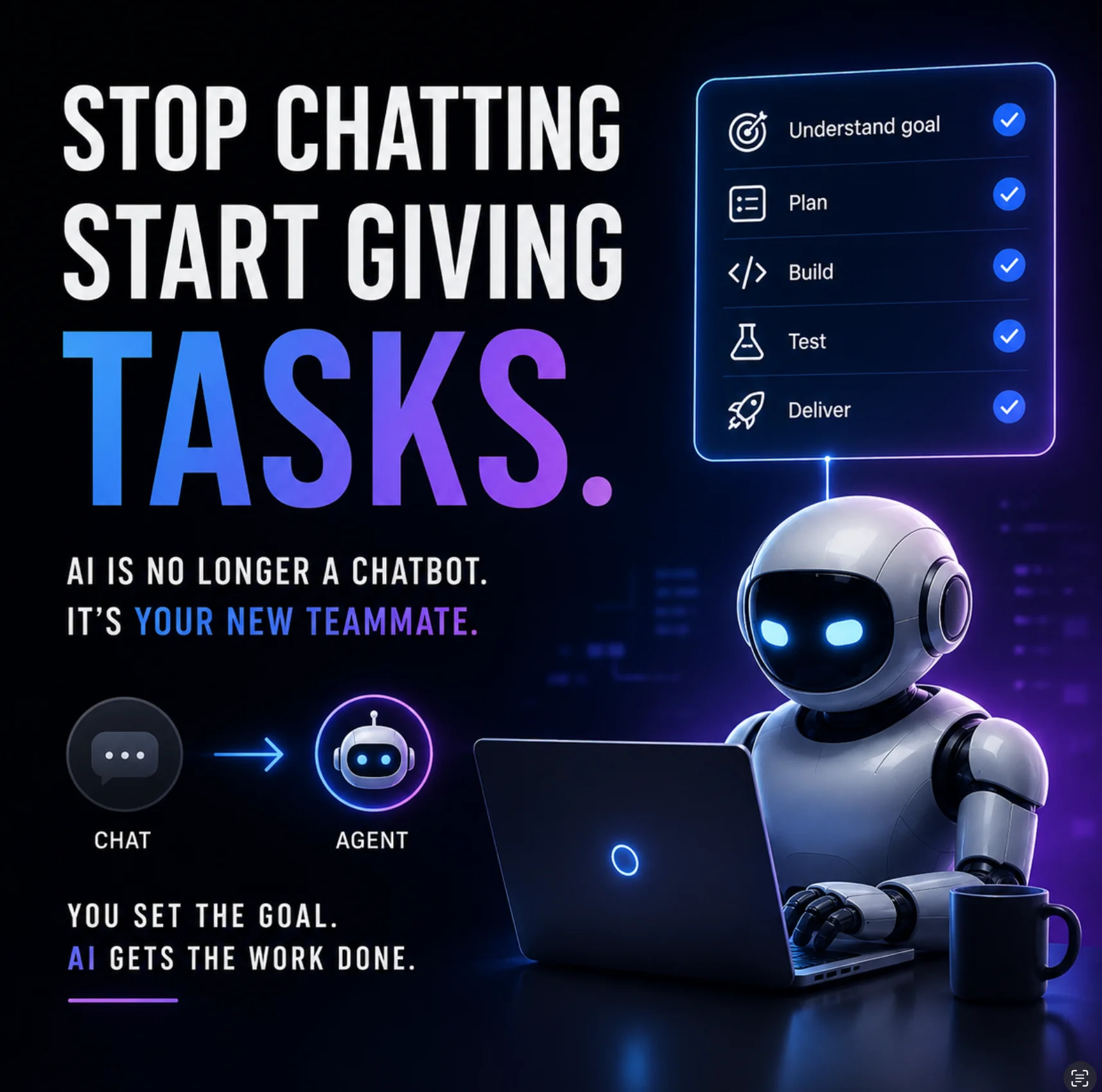
Recently, we've observed an intriguing shift in how we interact with artificial intelligence. AI is evolving from being just a conversational partner to becoming an integral part of the workflow.
From Conversation to Task Assignment
Previously, our interactions with AI were largely in a question-and-answer format. We would ask a question, AI would respond, and then we'd manually open necessary services, write code, manage tasks, and verify results.
Now, a new approach is emerging. Instead of simple conversation, we are beginning to assign tasks to AI as if it were an employee:
- "Build an MVP CRM for our team. Use data from the spreadsheet, create the structure, set up authentication, assign roles, prepare test data, deploy to staging, and show what needs to be checked."
Working in a Loop: The Agent Loop
AI is no longer just responding with text; it's starting to work in a cycle often referred to as the agent loop. This is a process where AI receives a goal, formulates a plan, reads context, opens files and services, calls tools, writes code, runs tests, identifies errors, and corrects them, aligning the result with the task. Human intervention is only necessary where decisions, access, or accountability are required.
Models like Claude Code and ChatGPT Agent are already showcasing this approach in practice, reading codebases, modifying files, executing commands and tests, exploring, and working within a browser.
Gemini: Agent-First Approach
Gemini is taking steps towards agent-first development, where AI acts as an editor, terminal, browser, and interacts with databases and external services. This gradually transforms AI from a mere executor to an active participant in business processes.
The Importance of Control and Role Distribution
Despite AI's advancements, important questions of control and responsibility remain. Who checks where the keys are kept? Who monitors the business logic? Who will stop a dangerous action?
Therefore, I believe the future is not about a single "super agent" managing the entire business, but about a system of agents with different rights and tasks:
- One searches for information.
- Another works with code.
- A third prepares documents.
- A fourth monitors tasks.
- A fifth checks the results of the previous one.
Humans become those who set goals, establish rules, grant access, and make final decisions.
A New Reality of Interaction
This interface shift means that AI is no longer just a tool for communication but becomes part of operational work. In a few years, we will likely say not "I talked to AI," but "I assigned a task to an agent, and it returned with results and a few questions requiring my decision."
What tasks would you first trust such an agent with completely, without constant oversight?

Alex Meleshko
Entrepreneur, CEO, and builder at the intersection of blockchain, AI, and startups.
Comments
No comments yet. Be the first!