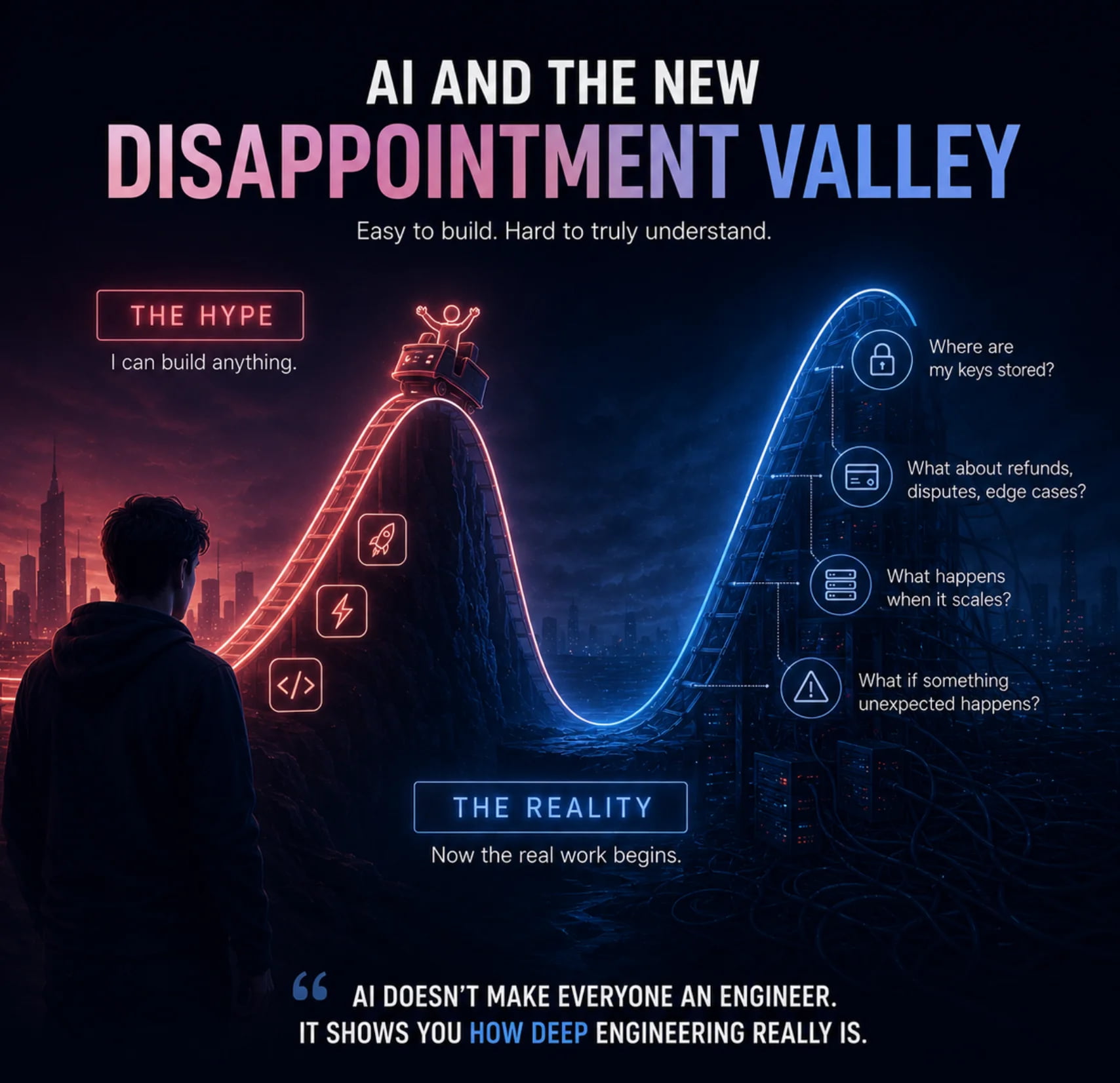
Lately, I've found myself having an interesting reaction: when I see a video that is entirely generated by artificial intelligence, I immediately feel less interested. Hearing music created with just the push of a button, its value in my eyes diminishes. Similar feelings arise when reading a text that, from the first lines, has that typical AI style. Even if the result isn't outright bad, something feels off.
Effort Heuristic
There's a psychological concept called the effort heuristic. We tend to value more highly what we believe has required greater effort. We admire a musician who plays an instrument virtuously because we understand that those few minutes of performance are backed by years of practice. We appreciate an artist not just for the painting but for the skill developed over decades. We respect an athlete for thousands of hours of training.
Handcrafted work seems more valuable than factory-made not always because it's objectively better. We see the time, attention, and involvement of a specific person. Thus, we perceive not only the finished object but also the story of effort behind it. AI breaks this connection. It can create an image, music, or text in seconds. Yes, the result can be quite good, but we know that years of practice by this specific author aren't behind it. And because of this, the emotional value automatically becomes lower.
Creativity and Human Involvement
A book for us is not just a sequence of words. Music is not only well-arranged sounds. A painting is not just a successful composition and colors. In creativity, we build a relationship with the author. We are interested in what they have experienced, why they chose this particular theme, what they wanted to convey. We spend time not only on the product but also on contact with another person. Therefore, knowing that material is entirely AI-generated can devalue it even before we've had a chance to assess its quality.
Business and Pragmatism
In business, everything works differently. Here, value lies not in the effort itself, but in measurable results. When a company orders a CRM, website, or application, it is interested in whether the product works, solves the business problem, is secure, can be scaled, and if the team met the deadlines and budget. The client rarely wants to pay more just because a programmer manually wrote the code for several months.
If AI helps achieve the same result faster, cheaper, and better, business will use it. That's normal. Business is a pragmatic environment. It has always strived to automate repetitive work, reduce costs, and increase productivity.
Two Different Values
Here lies an important distinction. When we buy a function, we care about the result. A car should drive, a program should work, a translation should be accurate. But when we buy meaning or a relationship with the author, human involvement is important: music, literature, photography, cinema, painting, personal blogs. In these areas, completely removing the human from the process is more difficult because the human is part of the product's value.
Therefore, AI will likely spread unevenly. In business processes, it will be adopted quickly because efficiency is easy to measure there. In creativity, audiences will still long seek proof that a human truly stands behind the work.
AI as a Tool
I don't believe that using AI automatically devalues work. For example, I dictated this text by voice, and AI helped me remove repetitions, correct punctuation, and organize my thoughts. But the observations, positions, and conclusions are mine. For publication, I also prefer to use a real photograph rather than a fully generated portrait. Not because AI can't create a beautiful image, but because I respect my relationship with my readers and don't want to replace myself with a synthetic image when it comes to personal thoughts and experiences.
For me, the boundary is roughly here: AI can help a person express an idea, but it shouldn't create the illusion of human experience where none existed. In the future, value will likely not be determined by the question "Did the author use AI?" Almost everyone will use it. A more important question will be: what exactly did the person do in this work? Did they bring their own thought, experience, taste, responsibility, emotion? Or did they just press a button and publish the first result they got?
Perhaps people aren't irritated by artificial intelligence. Perhaps we just very quickly notice when there's no author behind the content who truly had something to say. Do you notice this reaction in yourself? Does your attitude toward music, text, or image change when you learn it was entirely created by AI?

Alex Meleshko
Entrepreneur, CEO, and builder at the intersection of blockchain, AI, and startups.
Comments
No comments yet. Be the first!